Claude
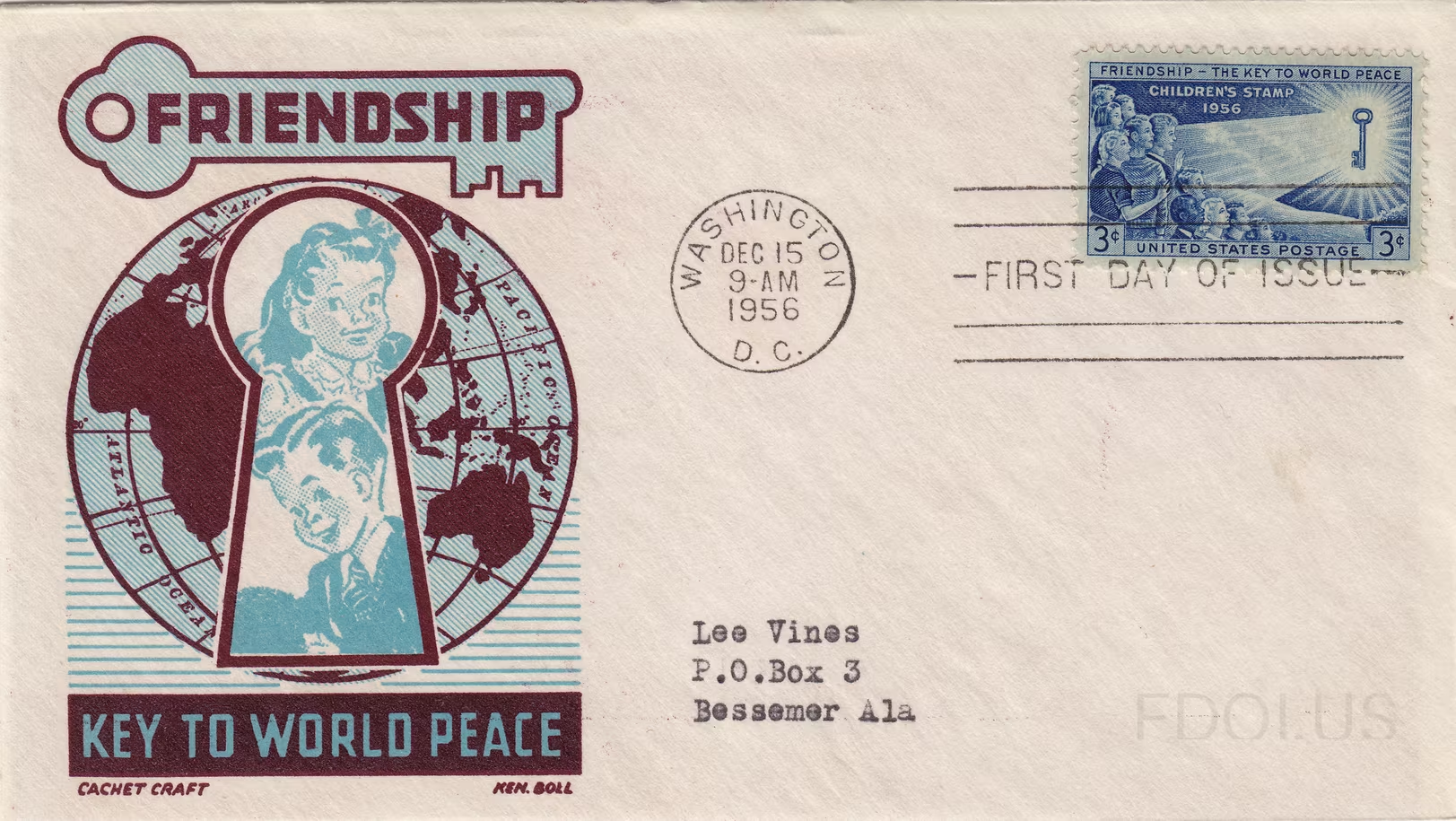
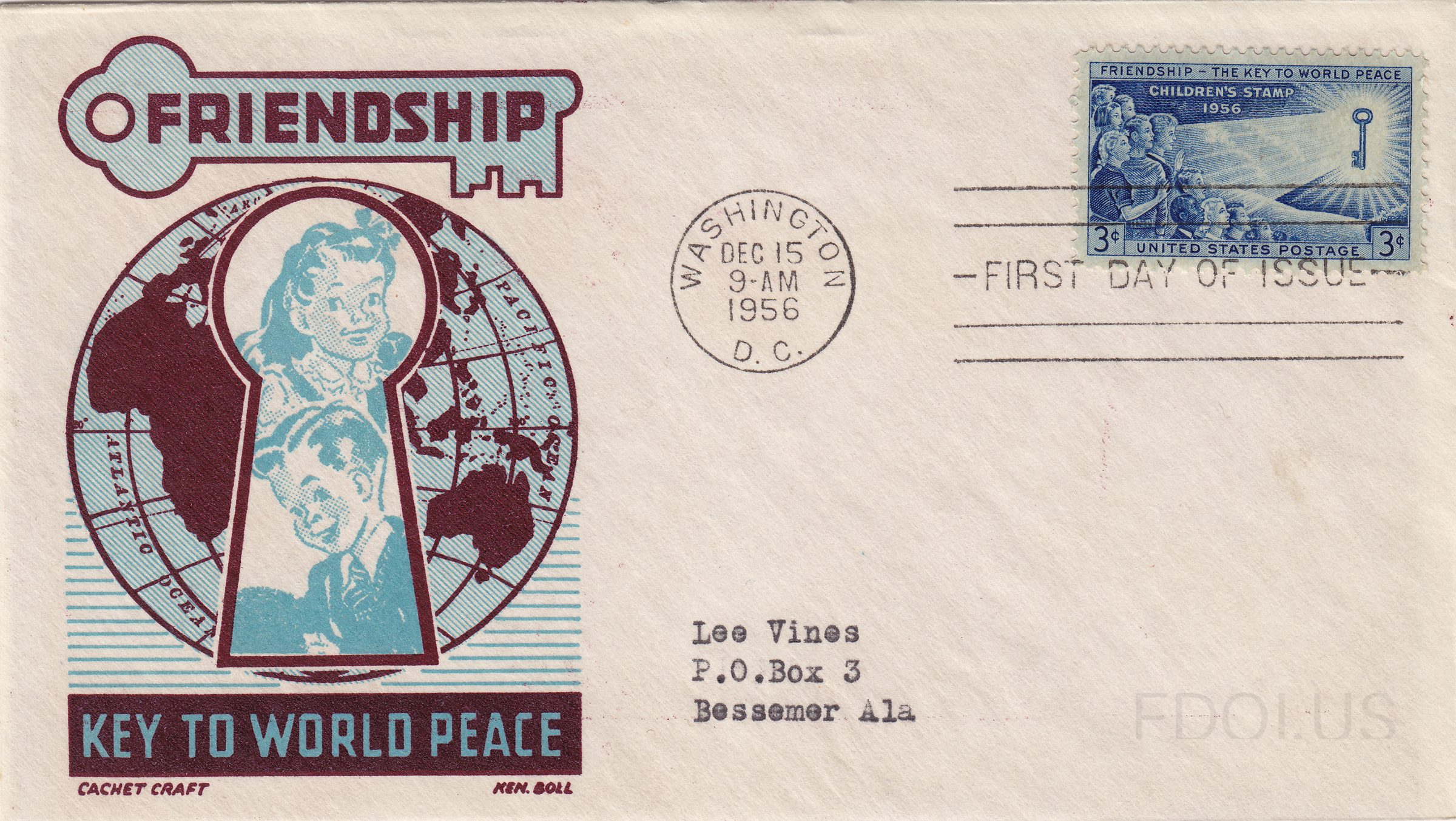
The Cachet Craft/Ken Boll cachet features a large skeleton key design at top with the word 'FRIENDSHIP' incorporated into it, rendered in dark maroon/burgundy and teal blue. A globe showing world continents is depicted in the center with a keyhole cutout revealing two children's faces (a girl and a boy), symbolizing international friendship and peace. The bottom banner reads 'KEY TO WORLD PEACE.' The 3-cent blue United States stamp (Scott #1085) depicts children and a large key with radiating rays, titled 'Friendship - The Key to World Peace / Children's Stamp 1956.' The machine cancel reads 'Washington D.C. / DEC 15 / 9 AM / 1956' with a 'FIRST DAY OF ISSUE' slogan cancel. The cover is addressed to Lee Vines, P.O. Box 3, Bessemer, Alabama, and is in very good condition.
Mistral
The cachet artwork features the word 'FRIENDSHIP' in bold red letters with a large skeleton key integrated into the design. Below, a globe with a keyhole cutout reveals two children's faces, symbolizing international friendship. The motto 'KEY TO WORLD PEACE' is printed in red at the bottom. The stamp, Scott #1085, depicts children from different nations holding hands in front of a globe with the inscription 'FRIENDSHIP - THE KEY TO WORLD PEACE.' The postmark is a circular machine cancellation from Washington, D.C., dated December 15, 1956. The cover is addressed to 'Lee Vines, P.O. Box 3, Bossemer, Ala.'
(The automatic summaries sometimes misidentify the postmark as part of the cachet artwork.)