Claude
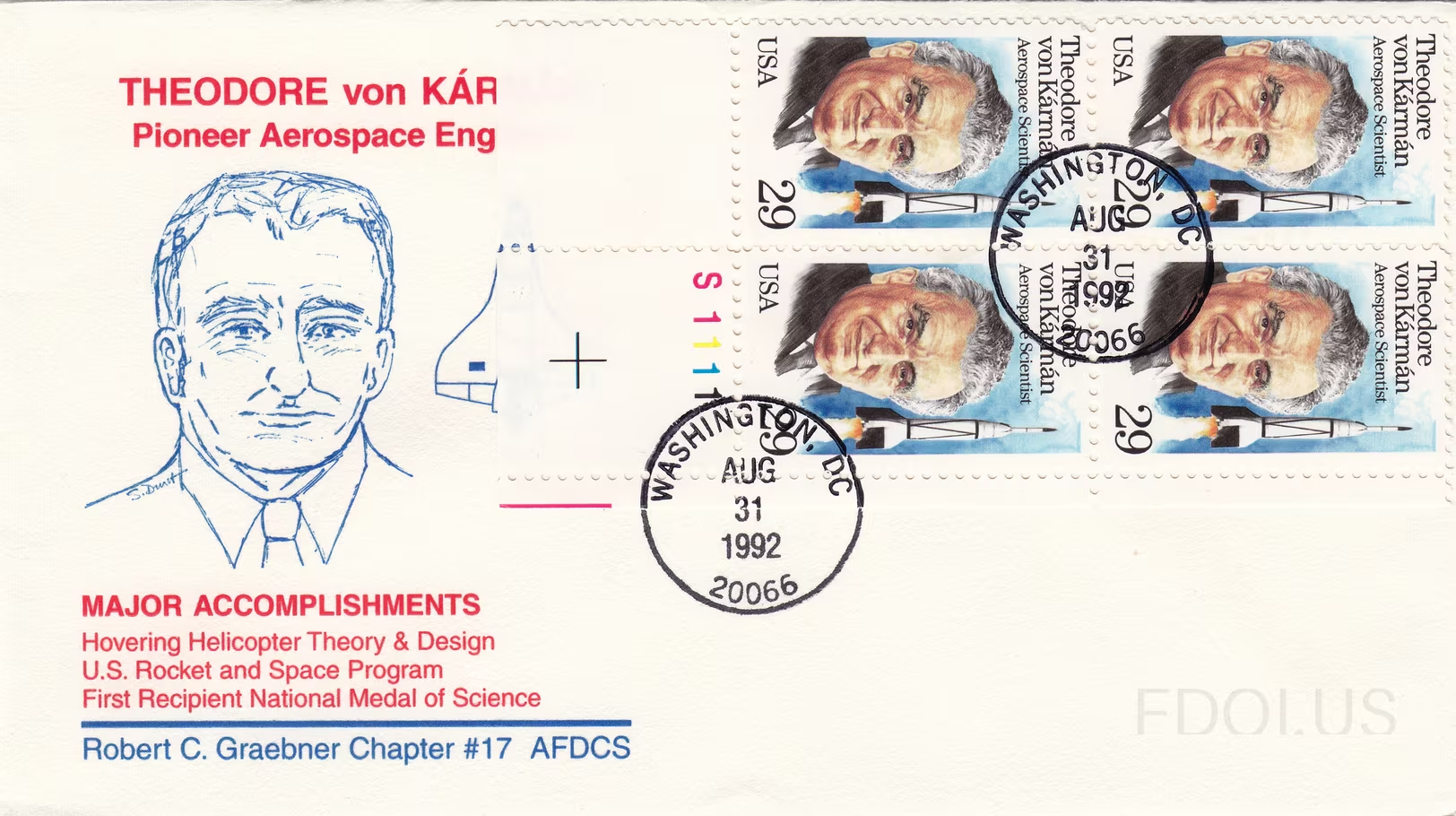
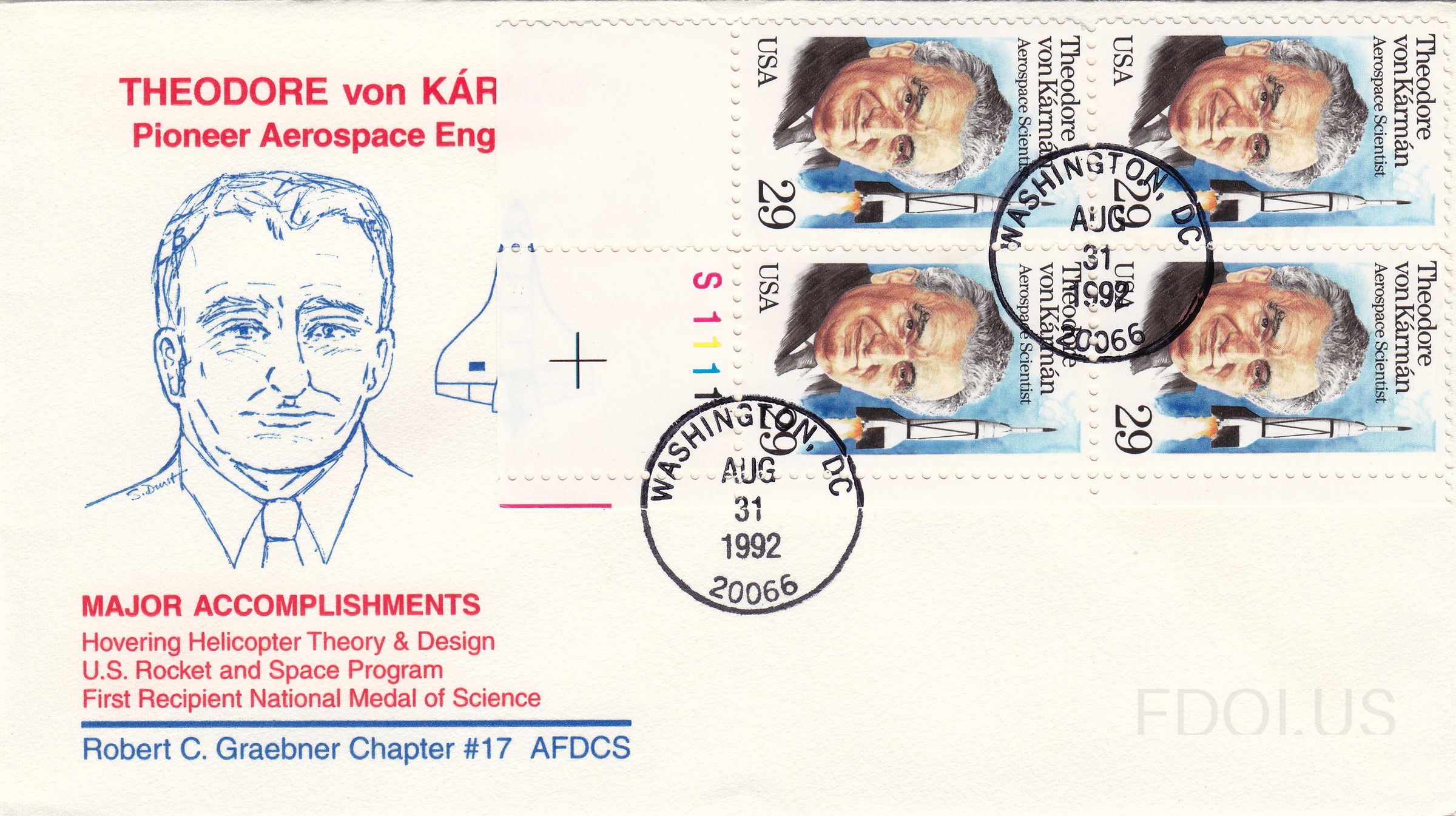
The cachet features a blue line-drawn portrait of Theodore von Kármán in suit and tie, alongside a small sketch of a space shuttle, with red and blue text listing his title as 'Pioneer Aerospace Engineer' and major accomplishments including Hovering Helicopter Theory & Design, U.S. Rocket and Space Program, and First Recipient National Medal of Science. A block of four 29-cent USA stamps depicts von Kármán as an elderly man with rockets in the background, identified as 'Aerospace Scientist.' The postmark is a black circular hand-cancel from Washington, DC dated August 31, 1992, with ZIP 20066, applied twice (double strike). The cover is unaddressed and in excellent condition.
Mistral
This First Day Cover features a blue line-drawn cachet portrait of Theodore von Kármán on the left, with 'MAJOR ACCOMPLISHMENTS' listed in red text, including his work on helicopter theory, the U.S. space program, and his National Medal of Science. The cover bears a block of four 29-cent USA stamps (Scott 2699) depicting von Kármán in color with rockets in the background. The stamps are cancelled with a circular postmark from Washington, DC, dated August 31, 1992, with a notable double-strike. Text on the cover identifies it as a souvenir from the Robert C. Graebner Chapter #17 AFDCS.
(The automatic summaries sometimes misidentify the postmark as part of the cachet artwork.)