Claude
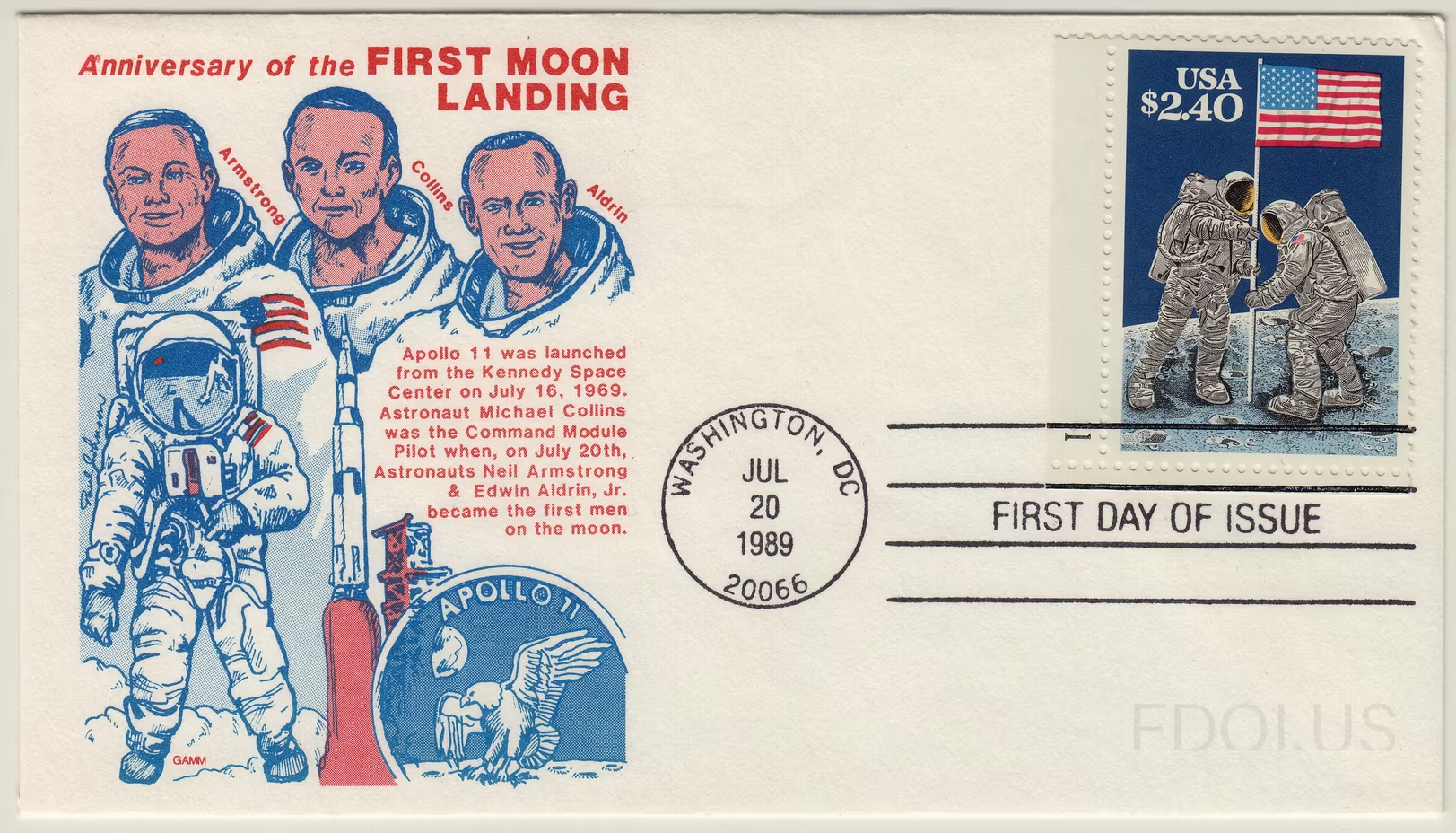
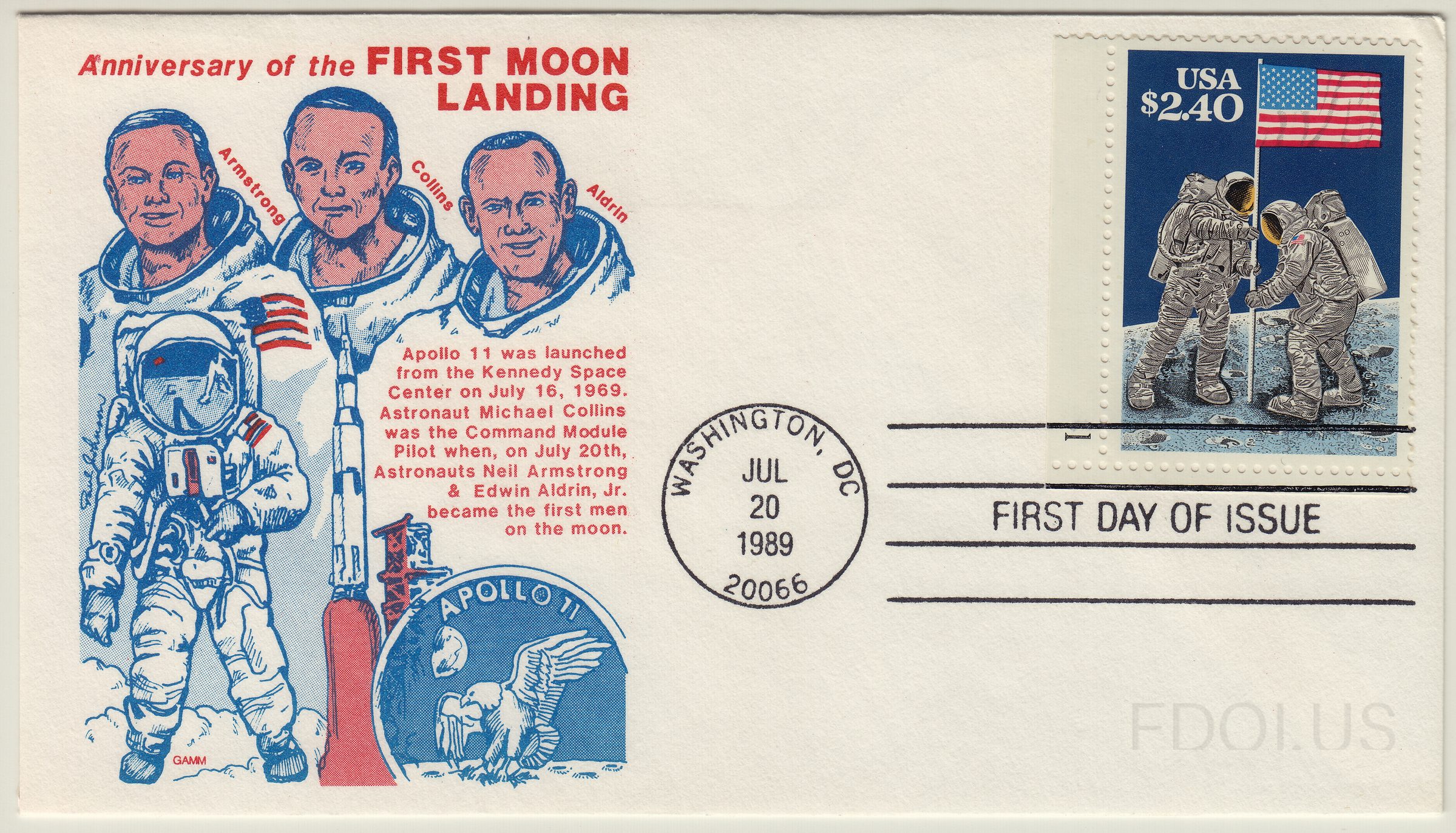
The cachet artwork by GAMM (Gerry Adlman) features a red, white, and blue illustration of the three Apollo 11 astronauts — Armstrong, Collins, and Aldrin — depicted in portraits at top with their names labeled, along with a full-suited astronaut walking on the lunar surface, a Saturn V rocket, and the Apollo 11 mission patch (eagle landing on the moon). Descriptive text recounts the Apollo 11 mission history. The stamp is the USA $2.40 Priority Mail issue depicting two astronauts planting the American flag on the lunar surface against a dark blue sky. The circular machine cancellation reads 'Washington, DC / JUL 20 1989 / 20066' with a printed 'FIRST DAY OF ISSUE' slug.
Mistral
This First Day Cover commemorates the 20th anniversary of the Apollo 11 moon landing. The cachet artwork features detailed portraits of astronauts Neil Armstrong, Michael Collins, and Buzz Aldrin in blue and red tones, along with an astronaut in a full spacesuit standing on the lunar surface, a Saturn V rocket, and the Apollo 11 mission patch with an eagle carrying an olive branch. The stamp depicts two astronauts planting the American flag on the moon, with a denomination of $2.40. The postmark is a circular machine cancellation from Washington, DC, dated July 20, 1989, with the text 'FIRST DAY OF ISSUE' printed below. The cover is in excellent condition with clear, vibrant colors.
(The automatic summaries sometimes misidentify the postmark as part of the cachet artwork.)